
Curved Stonework Makes a Comeback
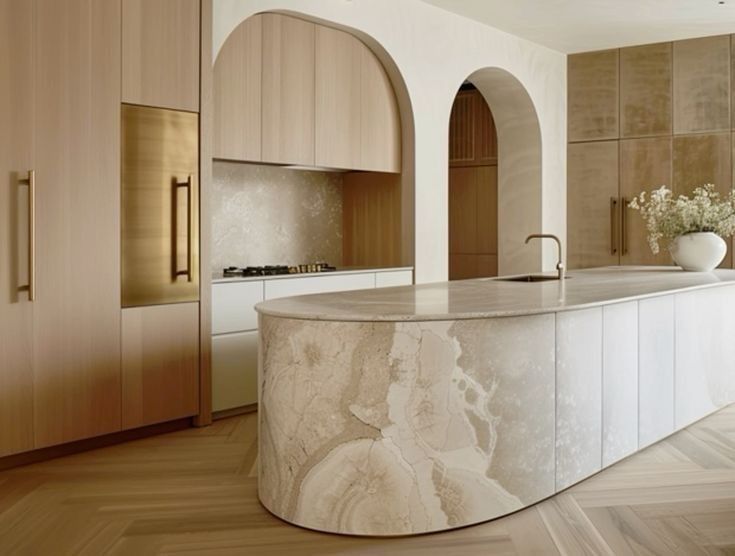
For decades, curved stonework belonged to the eras of the past. Roman and Gothic architecture served as prime examples of work carved by hand in natural stone, with even more artistic wonders emerging from the Renaissance.
Now, a new renaissance is on the rise. This time, crafted by sophisticated CNC machines.
With architects increasingly specing curved staircases, arches, and rounded features, stone shops across Australia are wandering outside their comfort zone. Those who have experience producing monuments and artistic works are at an advantage, having honed their craft through endless experiments using a variety of tools, textures, and machine settings.
On the other hand, stonemasons looking to break into this type of work are facing a learning curve (pun intended). But don’t worry – we’re more than happy to guide you along the way.
CNC machines for curved stonework
By nature, curved stonework is complex. Where a standard 3-axis CNC mill or waterjet did the job for most orders over the past decade or so, the more complex nature of non-linear work requires a CNC machine with a greater number of axes.
Look for at least 4.
Stone CNC machines like the CMS Maxima, which are used for crafting complex monuments and sculptural work, are ideal for these situations. The 5/6 interpolated axes carves and mills from twice as many angles as standard machines, enabling shops to match the effects found in historical buildings.
The Maxima was specifically built for this type of work – though not all shops need it. Some factories do very well with a 5 axis machining centre, multi-axis waterjet head, or a 5-axis bridgesaw.
If you have any of the above, making the switch the curved work is a question of time, trials, and tooling know-how. If you don’t, it’s time to explore further.
Weight up your options
Trends in architecture, like in all design, come and go. That said, architectural trends emerge from shifts in our way of life, and we’re in the middle of long-term change now.
With more people moving to outer suburbs and rural areas where more room is available, it’s easy to see why curved stonework is on the rise. With that in mind, demand for such work isn’t likely to go down anytime soon.

So, if you’re questioning whether or not the investment in a new stone CNC is worthwhile, we’d say it is.
The beauty of the above CNCs is that, with 5-6 interpolated axes, you can machine almost anything. That, in times of change, is a valuable asset to have.
On the other hand, a standard 3-axis machine leaves you locked in to linear work. The gap is evident.
While curved work isn’t for everyone, those who get into it get to grow. Skills wide, production wise, and revenue wise. The only downside is time spent looking for a machine and learning how to do the work required.
The latter we’ll leave to you – and the former, we’ll gladly help you with. Reach out if you’re ready to get started.
Related Articles
 https://innovync.com.au/wp-content/uploads/2024/05/pexels-kateryna-babaieva-1423213-2760241-scaled.jpg
3475
5212
Nicole Sherwin
https://innovync.com.au/wp-content/uploads/2022/07/Innovync-logo.png
Nicole Sherwin2026-03-02 12:11:292026-03-02 12:11:30Transforming Queensland Manufacturing Grants: Up to $1.5M Available for Advanced Manufacturing Investment
https://innovync.com.au/wp-content/uploads/2024/05/pexels-kateryna-babaieva-1423213-2760241-scaled.jpg
3475
5212
Nicole Sherwin
https://innovync.com.au/wp-content/uploads/2022/07/Innovync-logo.png
Nicole Sherwin2026-03-02 12:11:292026-03-02 12:11:30Transforming Queensland Manufacturing Grants: Up to $1.5M Available for Advanced Manufacturing Investment https://innovync.com.au/wp-content/uploads/2026/02/curved-stonework.jpg
920
736
Nicole Sherwin
https://innovync.com.au/wp-content/uploads/2022/07/Innovync-logo.png
Nicole Sherwin2026-02-23 16:49:352026-02-23 16:49:352026 Stone Industry Forecast
https://innovync.com.au/wp-content/uploads/2026/02/curved-stonework.jpg
920
736
Nicole Sherwin
https://innovync.com.au/wp-content/uploads/2022/07/Innovync-logo.png
Nicole Sherwin2026-02-23 16:49:352026-02-23 16:49:352026 Stone Industry Forecast https://innovync.com.au/wp-content/uploads/2025/07/systron-Processing-of-Thick-Jumbo-Glass_4.jpg
1050
1500
Nicole Sherwin
https://innovync.com.au/wp-content/uploads/2022/07/Innovync-logo.png
Nicole Sherwin2026-02-23 16:41:192026-02-23 16:41:202026 Glass Industry Forecast
https://innovync.com.au/wp-content/uploads/2025/07/systron-Processing-of-Thick-Jumbo-Glass_4.jpg
1050
1500
Nicole Sherwin
https://innovync.com.au/wp-content/uploads/2022/07/Innovync-logo.png
Nicole Sherwin2026-02-23 16:41:192026-02-23 16:41:202026 Glass Industry Forecast https://innovync.com.au/wp-content/uploads/2026/01/2025-Three-Completed-Ghost-Shark-Prototypes-scaled.jpg.webp
1107
2048
Nicole Sherwin
https://innovync.com.au/wp-content/uploads/2022/07/Innovync-logo.png
Nicole Sherwin2026-02-23 16:29:502026-02-23 16:29:512026 Advanced Materials & Plastics Industry Forecast
https://innovync.com.au/wp-content/uploads/2026/01/2025-Three-Completed-Ghost-Shark-Prototypes-scaled.jpg.webp
1107
2048
Nicole Sherwin
https://innovync.com.au/wp-content/uploads/2022/07/Innovync-logo.png
Nicole Sherwin2026-02-23 16:29:502026-02-23 16:29:512026 Advanced Materials & Plastics Industry Forecast https://innovync.com.au/wp-content/uploads/2024/08/automatic-slab-storage-system-with-gantry-crane.jpg
720
1280
Nicole Sherwin
https://innovync.com.au/wp-content/uploads/2022/07/Innovync-logo.png
Nicole Sherwin2026-02-23 14:53:232026-02-23 14:53:23Robotic Materials Handling: The secret to a growth boom?
https://innovync.com.au/wp-content/uploads/2024/08/automatic-slab-storage-system-with-gantry-crane.jpg
720
1280
Nicole Sherwin
https://innovync.com.au/wp-content/uploads/2022/07/Innovync-logo.png
Nicole Sherwin2026-02-23 14:53:232026-02-23 14:53:23Robotic Materials Handling: The secret to a growth boom? https://innovync.com.au/wp-content/uploads/2026/02/curved-benchtop.jpg
556
735
Nicole Sherwin
https://innovync.com.au/wp-content/uploads/2022/07/Innovync-logo.png
Nicole Sherwin2026-02-23 12:59:272026-02-23 12:59:27Curved Stonework Makes a Comeback
https://innovync.com.au/wp-content/uploads/2026/02/curved-benchtop.jpg
556
735
Nicole Sherwin
https://innovync.com.au/wp-content/uploads/2022/07/Innovync-logo.png
Nicole Sherwin2026-02-23 12:59:272026-02-23 12:59:27Curved Stonework Makes a Comeback https://innovync.com.au/wp-content/uploads/2026/01/Assembly-of-modular-home.webp
427
730
Nicole Sherwin
https://innovync.com.au/wp-content/uploads/2022/07/Innovync-logo.png
Nicole Sherwin2026-01-13 11:00:042026-01-13 11:00:05Why Robotics Are the Missing Link in Australia’s Prefab Housing Boom
https://innovync.com.au/wp-content/uploads/2026/01/Assembly-of-modular-home.webp
427
730
Nicole Sherwin
https://innovync.com.au/wp-content/uploads/2022/07/Innovync-logo.png
Nicole Sherwin2026-01-13 11:00:042026-01-13 11:00:05Why Robotics Are the Missing Link in Australia’s Prefab Housing Boom https://innovync.com.au/wp-content/uploads/2026/01/Virgina-Class-Submarine.avif
485
862
Nicole Sherwin
https://innovync.com.au/wp-content/uploads/2022/07/Innovync-logo.png
Nicole Sherwin2026-01-08 12:07:482026-01-08 12:08:32Maritime Manufacturing in Australia: A New Gold Rush?
https://innovync.com.au/wp-content/uploads/2026/01/Virgina-Class-Submarine.avif
485
862
Nicole Sherwin
https://innovync.com.au/wp-content/uploads/2022/07/Innovync-logo.png
Nicole Sherwin2026-01-08 12:07:482026-01-08 12:08:32Maritime Manufacturing in Australia: A New Gold Rush? https://innovync.com.au/wp-content/uploads/2025/09/SandRob-7-axes.jpg
400
700
Nicole Sherwin
https://innovync.com.au/wp-content/uploads/2022/07/Innovync-logo.png
Nicole Sherwin2025-12-09 13:12:062025-12-09 13:12:06Robotics replacements Myth or Manufacturing Reality?
https://innovync.com.au/wp-content/uploads/2025/09/SandRob-7-axes.jpg
400
700
Nicole Sherwin
https://innovync.com.au/wp-content/uploads/2022/07/Innovync-logo.png
Nicole Sherwin2025-12-09 13:12:062025-12-09 13:12:06Robotics replacements Myth or Manufacturing Reality?Get in touch
Looking for the right product for you, reach to our experts and let’s chat.

